

Point 13: testimony of war
Dear visitor, if you’ve arrived here, you can admire the beautiful panorama in front of you, but we would also like to draw your attention to another topic: the Second World War.
We would like to do it through the vivid story of peolpe who lived those tragic moments that have changed the history of the whole world forever.
We will entrust ourselves to the historical memory of one of our inhabitants, Silvio Roccheggiani, whose house is right in front of this listening point.
He contributed to enrich our book on San Vito.
“It’s hard to forget that period even if many years have passed.
In San Vito there have never been heinous clashes or bloody battles.
I remember very well that it was used by the Germans as a strategic position on a hill, close to the main road and at the same time difficult to reach and accessible in the event of a sudden attack.
The German Command was located in a house in via Cuppio.
The Colonels were here and they controlled and planned the various actions to be carried out, issuing orders.
They chose this decentralized position, which attracted less attention than the village, because it was difficult to bomb peasant houses scattered throughout the countryside.
In San Vito there were some lookout posts equipped with machine guns.
One was at the top of the street where I live, near the municipal water tank, and another location was where the Guidarelli family lives today, under the Romita.
In San Vito they dug a trench, next to the former schools where today there is a metal cross. Here there were usually a couple of Germans with a machine gun.
Under the Pianello, on the other hand, there was an anti-tank cannon that was supposed to block any tank that arrived near the town.
Every night there was a curfew, woe betide you to break it, you could lose your life.
The Germans at that time were just about ten, but to show that they were many more and that they weren’t afraid of anything, at night they fired off machine guns from different posts, simply to make noise and scare local people.
From Monte della Romita, where today there are radio receivers, there was a post in a very strategic position to control the accesses from “Ponte dei Sospiri”and shoot in case of emergency.
To communicate between the various posts, the Germans put telephone cables on the ground.
Anyone who approached was killed, as they constituted a very important link between the main command and the various posts located throughout the territory.
One detail that I remember well is that they had maps everywhere, they took obsessive attention to the knowledge of the territory and they knew it very well, sometimes even better than those who had lived here for a lifetime.
Despite this, the Germans have won many battles, but never a war.
I remember that at that time Mr. Catalani pretended to be a partisan who wanted to fight the Germans and help anyone who wanted to conspire against them.
On the day of the German retreat and the arrival of the allies, all traces of him had been lost.
So he was definitely a spy, who lived with our people and was ready to report to the German guards all the people who wanted to rebel against the regime.
Now I’m going to tell you a story that involved me personally.
At that time I lived with my family in the center of the village and precisely in Via Menchetti near the former municipal slaughterhouse.
I was about twenty years old, I was young.
It was August 16th, 1944 and in five days there would have been the long-awaited liberation by the allied troops.
Along the main road from Pergola to Marotta, that morning a German division was in retreat from south to north.
It was disturbing to see the very long line of trucks, jeeps and soldiers.
Suddenly the lookouts who went ahead along the road heard a shot. It had probably been shot at a hare near the Ponte dei Sospiri.
The lookouts gave the military caravan the order to stop and some jeeps detached from it and soldiers with machine guns headed towards the village of San Vito.
I was at home with my mother unaware of everything, but I was very worried that they look for me as I was a draft evader and I was liable to the death sentence.
The same could happen to those who escaped from the war.
SS guards surrounded the village ready to fire their machine guns.
When my mother noticed that a German patrol was arriving, she warned me and I, scared, immediately went out. While I was trying to jump the wall of the town I felt myself being taken by an arm and pulled down to the ground.
He was an SS guard.
In hindsight I can say that it saved my life because if I had climbed over the wall and started running towards the countryside, the guards posted under the walls would have thought that I had fired and that I was running away.
Don Omero arrived because he had been alerted by the screams and shots.
He was easily frightened, but on that occasion he was brave and saved my life.
In fact, he immediately asked the SS guard to speak with his superior.
He satisfied him and a young blond-haired soldier arrived starting to speak a perfect Italian with Don Omero.
After explaining that the population was calm and no one wanted to attempt on their lives, they freed me. Before leaving the village they refreshed themselves by drinking good wine in the cellar.
To make sure no one followed them, they blew up the Ponte dei Sospiri.
On August 21th, 1944 at 15.15 the volunteers of the Maiella Brigade, and immediately after the British allies, arrived in the village and definitively declared the end of hostilities and the liberation from the Nazi-fascist troops.
The Allies had been stationed for some time in San Pietro in Musio and were awaiting orders from the Command to advance and free the populations”.
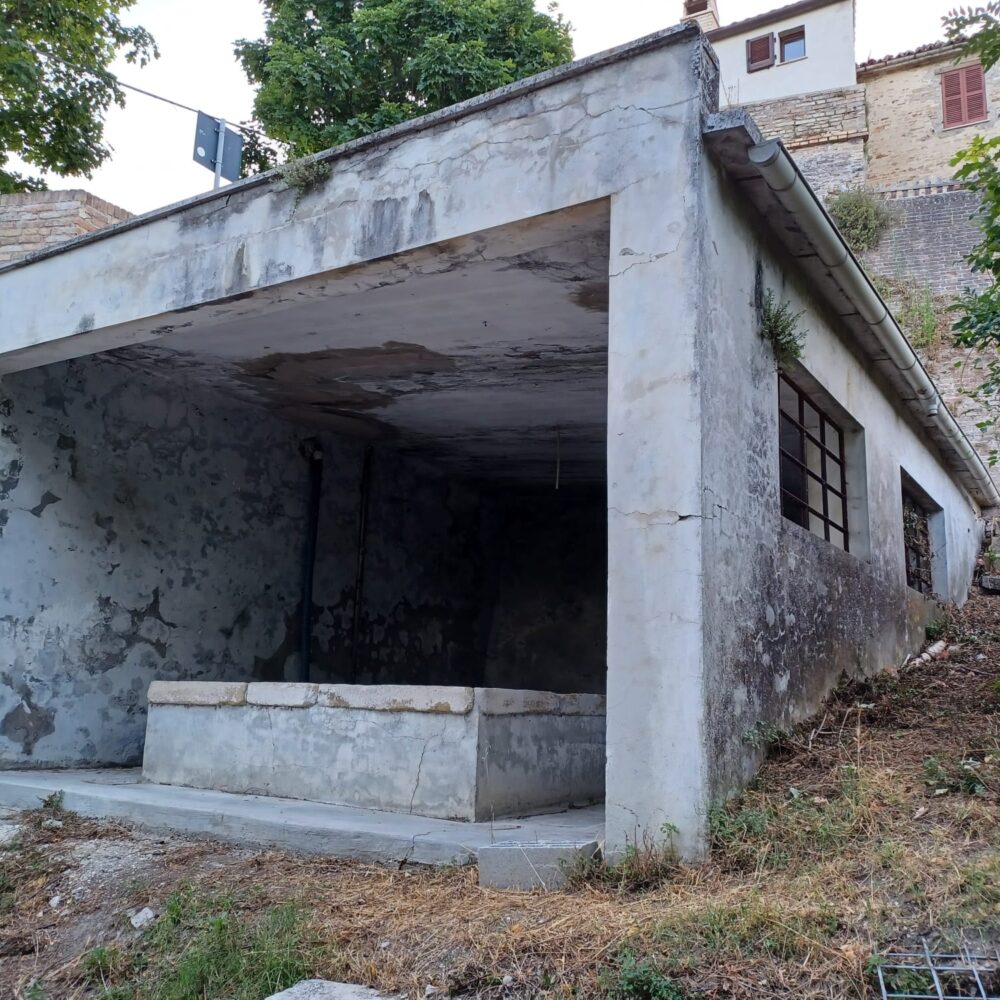
Point 14: old washhouses
Here you can see the old public wash houses, located right here, under the city walls. In the past when you needed to wash your laundry, and there was neither running water nor washing machines in the houses, you went to the nearby river or precisely to these public wash houses.
Go to point 14