

Point 1: Welcome to San Vito Sul Cesano
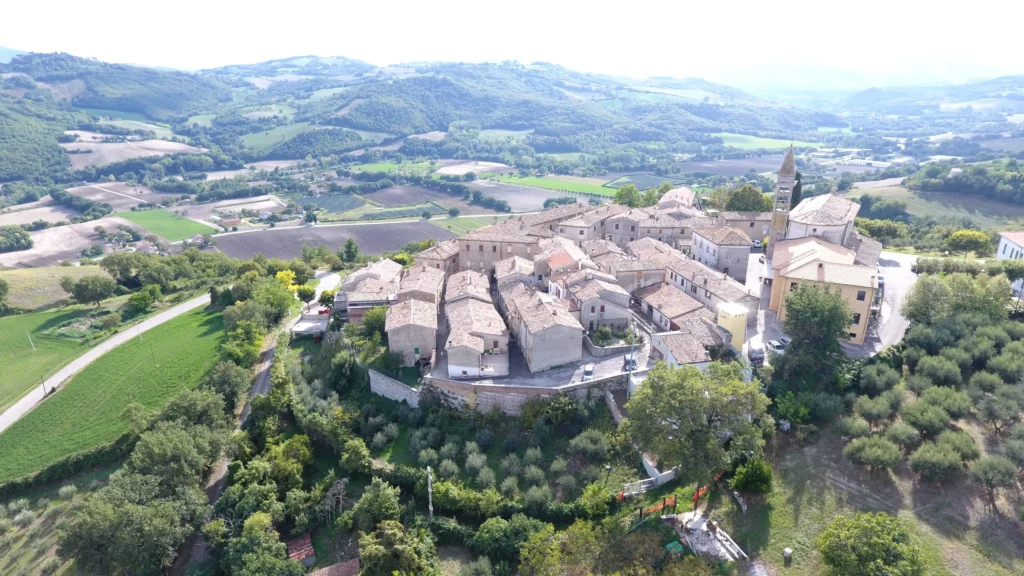
San Vito is a medieval village located at 354 meters above sea level and represents one of the most characteristic “natural balconies” of the entire Cesano river valley.
Its urban plan, surrounded by ancient walls and with the structure of internal alleys, called “fishbone”, makes it one of the villages wich better represents the classic scheme of urbanization, typical of the valleys of Marche Region.
In fact, from the arch-shaped stone entry gate, you can go up the steep rise called “Via F.lli Bandiera”, which ideally cuts the village in half, and which leads to the main square of the town, called “Piazza San Francesco”.
Many alleys branch off from the main road, from inside to outside, creating very suggestive views.
Almost all the alleys lead to the city walls, from where you can admire amazing panorama, from the Adriatic sea to Catria Mountain, passing through the gentle hills of Marche region.
The territory is rich of history. San Vito sul Cesano stands on Cesano River Valley, where the ancient Roman city of Suasa and the Benedictine Abbey of Romanesque era located in San Lorenzo in Campo were born and developed. On the slopes of Catria Mountain, the Hermitage of Fonte Avellana was founded by Saint Romualdo. Many churches and castles were built on the hills along the valley, on both sides of Cesano river.
The village of San Vito sul Cesano, like almost all villages located on the hills, was born from a precise path beginning with the Roman settlements at the bottom of the valley and ending on the hills.
During the barbarian invasions, in fact, the populations living in villages and towns located at the bottom of the valley, exposed to looting and destruction, sought refuge in the hills, where self-sufficient Roman villas or small monastic communities already existed. These ones offered shelter and security in exchange for work and manpower.
The mutual synergy gave rise to primitive fortifications, which were subsequently consolidated into city walls, bastions and stone and masonry access portals.
San Vito rises to the north of Pieve, an ancient village, probably a Roman village, located in the plain on the left of Cesano river. Thanks to its strategic geographical position, it achieved a considerable economic and social importance, due to trade with other peoples living along the valley, from the Adriatic sea to Catria Mountain.
The village was probably sacked and destroyed by the Barbarians led by Alaric, king of the Goths in 310 A.D., when he invaded the whole Cesano valley. From that moment the population moved to the hills, giving rise to the actual village.
The Dominican father Vincenzo Cimarelli was the first historian who wrote about this destroyed village. He lived between 1500 and 1600 and he was the author of the volume “History of Urbino Duchy”.
Cimarelli was born in the nearby Corinaldo village and carefully explored the ruins left by Barbarians in the Pieve area, including water pipes, primitive sewers, foundations of buildings, Capuchin tombs of a vast necropolis, as well as human bones, funerary vases, weapons, coins, gold jewels and many flints, called “flint arrows” – some of them still kept in the Antiquarium in San Lorenzo in Campo.
Some ornamental stone panels were also found and they are now set in the facade of the Church of “Old Pieve”.
But the most interesting finding is an important funerary epigraph, which certifies the importance of the Roman village of San Vito.
The epigraph was dedicated to two young soldiers, Marco Valerio Florenzio and his brother Marco Valerio Herodio, by their parents.
We don’t know if the two army officers began their career in the nearby Roman city of Suasa, or elsewhere, but their parents certainly lived in the important urban center, rich and of considerable demographic and economic interest.
Nowadays the epigraphic monument is now kept in the National Gallery of Urbino.
Unfortunately the name of the place where the epigraph was found is not known since no systematic excavations have been carried out in the past and many finds have been lost.
Not even the attention paid to it by Ludovico Antonio Muratori, an eighteenth-century historian and intellectual, considered the father of Italian historiography, was able to establish its origin or tell us anything more.
In this ancient place there is the Church of the ” Old Pieve “ belonging to the monastery of Sant’Appollinare in Classe in Ravenna since 1037, as written on an ancient parchment.
Inside the Church there is a valuable painting of “Grieved Virgin Mary” dating around 1800. The Virgin Mary is absorbed in contemplation of the symbols of the passion of her son, Christ, in the lower part of the painting: the crown of thorns, the tip of the bloody lance and a goblet with three huge nails.
The ancient history of San Vito sul Cesano, therefore, has its roots in the mists of time.
The territory was flourishing, it was in a favorable position due to the presence of fertile land, water and a mild climate and since the Stone Age it was occupied by nomadic tribes and shepherds. Subsequently the rural village was inhabited by the Umbrians, the Etruscans, the Celts or Gauls Sénoni and then by the Romans.
After the end of the Western Roman Empire, the territory including San Vito passed under the jurisdiction of the Exarchate of Ravenna. In this period the Church of the Old Pieve, with the annexed monastic centre, was founded.
Then, San Vito was under the domination of the nearby city of Fano, but was periodically disputed between Malatesta and Sforza families.
In the second half of the fifteenth century San Vito passed under the power of Giovanni della Rovere and thus became part of the rich and prosperous duchy of Urbino, but when he died the entire territory returned to be part of the Papal State.
During the Napoleonic domination, for a short time, it was included in the canton of Pergola, then, when the dominion of the Pope was restored, it passed to Serra Sant’Abbondio.
After the unification of Italy, a Royal Decree established that the municipality of San Vito should be called San Vito sul Cesano, but in 1868, a few years later, it was annexed to the municipality of San Lorenzo in Campo, becoming one of its districts.
At that time it had an urban population of 176 inhabitants, and an agricultural population, spread over its vast territory, of 460 inhabitants; it had a primary school, a Monte Frumentario (authorities set up to distribute wheat and barley to poor farmers, with the obligation to return) and a charity congregation.
In the only medieval gate still existsing, the coats of arms of the Malatesta, Montefeltro and Della Rovere families are still visible.
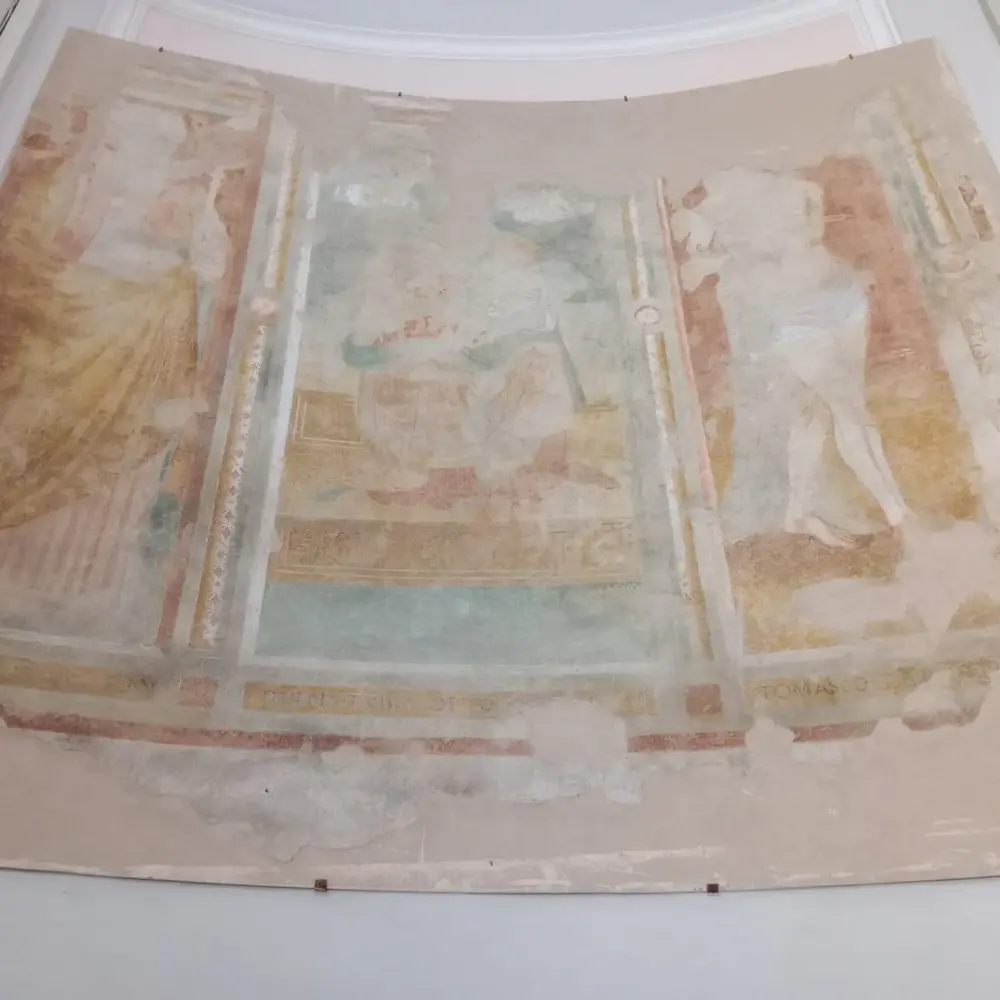
Point 2: the parish church of San Vito sul Cesano
It was rebuilt on the walls of the old Church, but with a new and vague Baroque style design with a single nave, with the addition of the large chapel and semicircle choir.
Point 2: The parish church of San Vito sul Cesano